
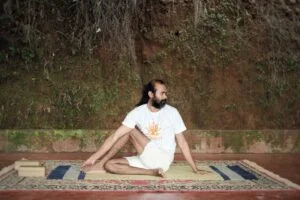
Ardha Matsyendrasana Pose and Its Benefits
Ardha Matsyendrasana, also known as the “Half Lord of the Fishes Pose,” is named after Matsyendranath, the great yogi credited with the creation of Hatha Yoga.
The Sanskrit terms “Ardha” means “half,” “Matsya” means “fish,” and “eendra” means “king.” The English name “Half Lord of the Fishes Pose” is derived from these roots. It is also referred to as the Half Spinal Twist Pose or Vakrasana (twist). This seated spinal twist is a fundamental posture included among the twelve basic Hatha Yoga poses (asanas).
In this pose, the spine experiences the deepest twist at the upper back, with the thighs crossed and the torso rotating using arm leverage.
Anatomy
Ardha Matsyendrasana benefits the following muscles:
- Arms and Shoulders
- Hamstrings
- Hips
- Hips-Internal
- Psoas
- Lower Back
- Middle Back
- Core (Abs)
- Gluteus
Steps for Ardha Matsyendrasana
- Lie flat with your legs stretched forward. Slightly elevate your right leg, bend it, and tuck it beneath the right sitting bone.
- Bend the left knee, placing the left foot beside the right thigh.
- Bend the right knee, cross the right foot over the left thigh, and place it on the floor next to the left hip.
- Inhale deeply and twist your upper body to the right. Place your right hand behind you on the floor near your lower back.
- Wrap the left arm around the right knee, gripping the right foot. Keep the left elbow on the outer side of the right knee.
- Exhale and deepen the twist, placing your right hand on your hip or lower back.
- Maintain alignment: chest, shoulders, and face should be facing the same direction.
- With each inhale, lift the sternum. With each exhale, twist deeper.
- Distribute body weight evenly to maintain balance. Ensure both sitting bones are grounded.
- Hold the position comfortably. Then, release, extend your legs forward, and relax.
- Repeat on the opposite side by bending the opposite leg and twisting in the other direction.
- Come out of the pose and unwind in Dandasana.
Modifications for Ardha Matsyendrasana
- Use a blanket for support under the buttocks if you’re a beginner.
- Hug the bent knee to the chest before twisting.
- Use both arms to hold the bent knee to open hips gradually.
- Practice against a wall for support. If twisting to the right, press the right palm into the wall to deepen the twist.
- Repeat for the left side in the same manner.
Contraindications to Ardha Matsyendrasana
- Injury and Surgery: Avoid if you have serious neck or back issues, or a slipped disc. Those with internal organ issues should practice caution.
- Lack of Breath-Body Coordination: Synchronizing movement with breath is crucial. Poor coordination may lead to injury or instability.
- Others: Pregnant women and elderly people with joint weakness should avoid this pose as it puts pressure on the abdomen.
Ardha Matsyendrasana Benefits
1. Stretches, Strengthens, and Lengthens
This pose increases flexibility in the back, hips, legs, and upper abdomen. It also tones the muscles and promotes hip strength.
2. Flexibility and Range of Motion
Provides full spinal rotation from bottom to top, toning ligaments and nerves. Improves spinal flexibility and prepares you for advanced yoga poses.
3. Chest, Diaphragm, and Breath
Twists and opens the chest, shoulders, and neck, enhancing deep breathing. This helps hold the pose longer without fatigue.
4. Awareness and Focus
Promotes breath awareness. Inhale to lengthen the spine, exhale to deepen the twist. This rhythm improves mind-body coordination.
5. Alignment and Posture
Requires precise folds and alignment for correct posture. Proper execution minimizes injury and supports long holding.
6. Energizing and De-stressing
Twisting releases tension in the lower and upper back, shoulders, and spine, leaving the practitioner relaxed and rejuvenated.
7. Stimulation and Organ Function
Massages abdominal muscles and internal organs like the liver, spleen, kidneys, heart, and lungs. Improves digestion, relieves constipation, and detoxifies tissues.
8. Treatment, Recovery, and Illnesses
Balances asymmetry in the body by addressing stiffness on one side. Supports emotional balance, nervous system health, and internal calmness.
9. Women’s Health
Helps regulate menstrual cycles and supports hormonal balance, especially during menopause or perimenopause.
FAQ
What are the beginner’s tips for Ardha Matsyendrasana?
Place a blanket under your sitting bones for support. Using a wall behind your back can help maintain posture, but it requires proper control and is not advised for solo beginners.
What are the common mistakes to avoid?
- Hips lifted off the ground
- Torso leaning backward
- Right ankle/toes not held by the left hand
- Left knee raised off the floor
- Chin not parallel to the ground