
Revolved Head on Knee Pose (Parivrtta Janu Sirsasana) and Benefits
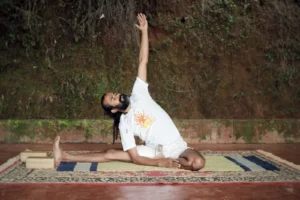
Revolved Head-on-Knee Pose, or Parivrtta Janu Sirsasana in Sanskrit, is a deep twist that strengthens the legs and core while stretching the entire body. The term breaks down as follows: Parivrtta means revolved, Janu refers to the knee, Sirsa means head, and Asana means posture.
This gentle pose works well as a cool-down in flow yoga sequences. It relaxes the neck, back, and legs, making it especially beneficial for students, office workers, athletes, and seniors. Twisting with a forward bend stretches and strengthens the glutes, hamstrings, and spine, while also massaging internal organs.
When to Practice
Revolved Head-on-Knee Pose is usually performed after warming up the body, often in the second half of a yoga class. Practicing it regularly improves joint mobility, particularly in the hips, shoulders, and knees, and supports better posture.
Steps to Perform Revolved Head on Knee Pose
-
Sit in a wide-legged straddle position (Upavistha Konasana).
-
Flex your right knee and place the sole of your right foot against the inside of your left thigh.
-
Inhale and lift your arms overhead.
-
Exhale and tilt your torso to the left, bringing the back of your left forearm to the floor inside your left leg. (Use a block if needed.)
-
Begin rotating your upper body away from the left leg as you exhale, opening your chest toward the ceiling.
-
Lift your head and neck, following the curve of your spine, and gaze upward.
-
Extend your right arm overhead, keeping it straight and aligning your bicep with your ear. (Optional: Bend your right elbow and support the head with your hand.)
-
Keep your left foot flexed.
-
After several breaths, slowly release the twist and return to center.
-
Switch legs and repeat on the other side.
Benefits of Revolved Head on Knee Pose
Stretches, Strengthens, and Lengthens
The combination of twisting and forward bending engages the legs, back, and torso, supporting the hips and shoulders. The pose stretches the hamstrings, psoas, and glutes while strengthening the upper and middle back, core, and neck. It also opens the heart and hips, enhancing flexibility and strength.
Flexibility and Range of Motion
Rotating the upper body while keeping one knee bent increases mobility in the spine, shoulders, neck, and legs. This pose prepares the body for advanced twists such as Revolved Triangle Pose or Revolved Lunge Pose.
Chest, Diaphragm, and Breath
This pose gently opens the heart and stretches the rib cage, upper back, and shoulders. As a result, intercostal muscles expand, improving lung function and enhancing breath awareness during practice.
Posture and Alignment
The grounding effect of the bent knee, combined with spinal extension, releases tension in the shoulders, back, and legs. The twist encourages an open chest, better posture, and the smooth flow of energy (prana), helping to ease mental stress.
Organ Stimulation
The twist and forward bend gently massage the abdominal muscles, stimulating internal organs and aiding digestion. Rotating the neck also supports thyroid function and promotes overall hormonal balance.
Accessibility and Other Benefits
Though gentle, this pose requires a warm-up of the back and hips. It strengthens the arms, shoulders, and spine and prepares the body for forward bends and deeper twists. It is accessible to those with limited mobility and can be performed on the floor or seated on a bed.
Recommended Warm-Up Poses
To prepare for Revolved Head on Knee Pose, try:
-
Seated Side Straddle Pose
-
Three-Legged Downward Facing Dog
-
Half Bound Forward Fold Pose
These poses loosen the hamstrings, hips, and lower back, enhancing comfort and effectiveness during the twist.