
The History of Yin Yoga: Origins, Evolution, and Benefits
Yin Yoga is a meditative, slow-paced style of yoga that emphasizes deep stretching, long-held poses, and inner stillness. Drawing inspiration from Chinese medicine and Taoist philosophy, Yin Yoga targets the deep connective tissues, ligaments, joints, and fascia—areas that dynamic yoga styles often neglect.
Although it feels modern, Yin Yoga’s origins trace back to ancient spiritual and physical practices. However, it was in the 1970s that the style began to take its modern form and gained popularity in the West.
Who Created Yin Yoga?
The modern form of Yin Yoga came from Paulie Zink, a martial arts expert and Taoist yoga teacher. He combined ancient Chinese principles and Kung Fu training methods that emphasized both flexibility and stillness. Zink blended Taoist yoga with Hatha Yoga elements and created what we now recognize as Yin Yoga.
The Yin Yoga Evolution: Paul Grilley and Sarah Powers
Paul Grilley, one of Zink’s students, refined the practice further. He explored long-held, passive postures and removed dynamic or “Yang” movements between poses. With his background in anatomy and meridian theory, Grilley integrated Traditional Chinese Medicine (TCM) concepts, aligning Yin Yoga poses with the body’s energy meridians used in acupuncture.
Grilley also studied under Dr. Hiroshi Motoyama, a Japanese scholar who combined science and spirituality. Motoyama’s work on energy and meridians helped Grilley understand how Yin Yoga influences Chi (Prana) within the body.
Meanwhile, Sarah Powers, another student of Grilley, added her own insights. She emphasized mindfulness and meditation, officially naming the style “Yin Yoga.” Her teachings helped spread the practice throughout the United States, Canada, and Europe.
Benefits of Practicing Yin Yoga
Yin Yoga goes beyond passive stretching. It offers numerous physical, mental, and energetic benefits.
-
Calms the mind and reduces anxiety: Long-held poses activate the parasympathetic nervous system, which promotes deep relaxation.
-
Improves blood circulation: Gentle compression and release movements enhance vascular health and energy flow.
-
Increases flexibility: Yin Yoga targets deep connective tissues and fascia, which release under slow, steady pressure.
-
Releases fascia and improves joint mobility: Extended holds allow the body to release built-up tension in joints and soft tissues.
-
Balances internal organs and energy flow: Stimulating the meridian lines supports organ health and restores energetic balance.
What Is Modern Yin Yoga?
Modern Yin Yoga combines Hatha Yoga postures, Taoist philosophy, and Chinese acupuncture principles. Unlike dynamic or Yang-based styles that focus on the outer muscles, Yin Yoga works on the deep tissues and energy meridians.
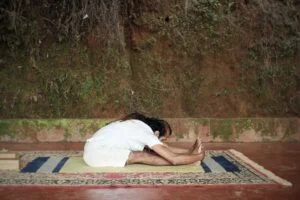
Practitioners are encouraged to find their “edge”—a point where they feel a gentle stretch but no pain. Once they reach it, they hold the pose still for three to ten minutes. This stillness allows tissues to release, energy to move freely, and the mind to settle.
Foundational Yin Yoga Poses
Here are a few signature Yin Yoga poses that reflect the essence of the practice:
1. Shoelace Pose
Target areas: Hips, lower spine, inner thighs, groin
Benefits: Opens hips, decompresses the lower back, and stimulates liver, kidney, and gallbladder meridians
You begin in a seated position and adjust the pose for comfort. Folding forward deepens the stretch and activates internal organs.
2. Dragonfly Pose
Target areas: Hamstrings, inner thighs, groin, lower back
Benefits: Activates kidney, spleen, liver, and urinary bladder meridians
This wide-legged seated forward fold encourages side bends and gentle twists. These variations enhance flexibility and improve blood flow through the torso.
3. Sphinx Pose
Target areas: Spine, sacrum, abdomen
Benefits: Stimulates kidney meridian, strengthens the lower back, and opens the chest and abdomen
Sphinx Pose is a mild backbend that supports spinal health and stimulates Chi flow through the kidneys. Over time, you can gradually deepen the posture as flexibility improves.
Final Thoughts: The Gentle Power of Yin Yoga
Yin Yoga may appear soft, yet its impact runs deep. It teaches practitioners to slow down, breathe consciously, and explore awareness beneath the surface of the body. Moreover, it enhances patience and mindfulness.
While many use Yin Yoga to complement more active practices, others find it a complete meditative path on its own. With regular practice, it balances energy, improves mobility, and nurtures emotional stillness.