
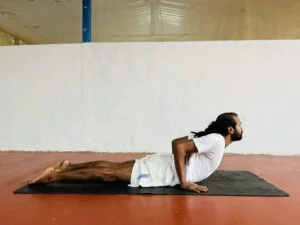
Bhujangasana is the infant of backbends, which can be practiced with either an active or passive approach.
The Sphinx Pose is a basic backbend in which the body resembles a mythical sphinx—the half-lion creature portrayed in Egyptian statues and pyramids. This beginner version of the Cobra Pose has you lying on your stomach, supporting your weight with your forearms while bending your back slightly.
Salamba Bhujangasana, also known as “Supported Cobra Pose,” comes from the combination of Sanskrit words:
- “Salamba” (supported)
- “Bhujanga” (cobra or serpent)
- “Asana” (pose)
“Sa” means “with,” and “Alamba” means “support.” Your forearms, which help lift your upper body in the pose, serve as the “support.” Because of the pose’s resemblance to the mythical half-lion creatures in ancient Egyptian statues, it is often referred to as the Sphinx Pose.
At the beginner level, students are introduced to Salamba Bhujangasana (Sphinx Pose), a gentle backbend that’s part of the prone poses category. As part of a backbend yoga sequence, this pose is easy on the lower back and helps open the chest—acting as a natural heart opener.
After a long day, the Sphinx Pose is a beautiful way to stretch and strengthen the back. Even with just five minutes, pressing up onto your forearms allows the pose to do what it does best.
Step-by-Step Instructions for the Sphinx Pose
- Lie on your stomach with legs extended.
Lengthen your tailbone toward your heels and firm it toward your pubis. Roll your outer thighs down to rotate the thighs inward. This widens and lengthens your lower back and sacrum (the triangular bone at the back of the pelvis), protecting them during the backbend. - Engage your toes by actively reaching them toward the wall behind you.
Continue lengthening your tail toward your heels to protect your lower back. Keep your buttocks firm but not clenched. Keep your tongue, eyes, and brain relaxed while your legs stay active. - Place your forearms parallel to the floor with elbows under your shoulders.
Inhale and gently lift your upper torso and head off the floor, creating a mild backbend. - Bring awareness to your lower belly—just above the pubic bone and below the navel.
Slightly draw it in to form a subtle dome curving toward your lower back. This gentle lift supports the spine and distributes the curve evenly, calming your lower back while awakening the upper back. - Hold the pose for 5–10 breaths.
Exhale as you slowly release the belly, then lower the head and torso back down. Turn your head to one side. - Rest quietly, breathing deeply.
Expand your back with every inhalation and release tension with each exhalation. You may repeat the pose 1–2 more times if desired.
Sphinx Pose Benefits
Stretches and Strengthens
- Stretches the arms, chest, shoulders, abdomen, neck, and entire spinal muscles
- Strengthens the arms, spine, and glutes
- Supports the pelvis, spine, and hips
Blood Circulation and Nervous System
- Enhances blood oxygen levels and circulation
- Stimulates joints (hips, spine, rib cage, shoulders, etc.)
- Activates the nervous system, improving nerve function
Posture and Toning
- Helps correct spinal posture and preserve natural spinal curves
- Beneficial for those with hunched backs
- Strengthens and tones the shoulders, chest, abdomen, and pelvis
- Can relieve back or neck pain when practiced with guidance
Internal Organs and Massage
- Activates adrenal glands and kidneys through abdominal stretch
- Stimulates the digestive system
- Increases lung capacity with chest expansion
Stress and Exhaustion
- Gently stretches hips and psoas muscles
- Opens the lower back, reducing stress and anxiety
- Ideal for nighttime yoga to ease fatigue and promote relaxation
Contraindications to Sphinx Pose
Injury or Stiffness
- Avoid if there’s injury to the spine, neck, shoulders, or hips
- For stiffness, use support—such as a bolster under elbows
Women
- Pregnant women should avoid this pose due to abdominal pressure
Spondylitis
- Those with neck issues or spondylitis should relax the neck
- Keep the chin close to the chest or gaze downward
- Discontinue if any discomfort arises
Contact Us