

Panchamahabhuta and Tridosha in Ayurveda
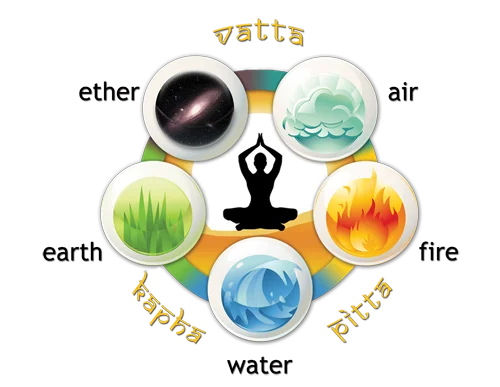
Ayurveda views the universe—including the human body—as composed of five fundamental elements, known as the Panchamahabhuta:
- Akasha (Space/Ether)
- Vayu (Air)
- Agni (Fire)
- Jala (Water)
- Prithvi (Earth)
These five elements combine in various ways to form all matter and energy in the cosmos, including the three biological energies or Doshas: Vata, Pitta, and Kapha.
The Five Elements (Panchamahabhuta)
| Mahabhuta | Properties | Sense Organ Association |
|---|---|---|
| Akasha (Space) | Frictionless, empty, expansive | Ear (Hearing) |
| Vayu (Air) | Light, mobile, subtle, touch | Skin (Touch) |
| Agni (Fire) | Transformative, hot, radiant | Eyes (Sight) |
| Jala (Water) | Fluid, cohesive, flowing | Tongue (Taste) |
| Prithvi (Earth) | Solid, stable, grounded | Nose (Smell) |
Deeper Insights into Each Element
1. Akasha (Space/Ether)
- Represents all empty cavities, pores, and channels in the body.
- Provides room for all bodily processes to occur.
- Related to sound perception.
2. Vayu (Air)
- Responsible for movement, such as nerve impulses, muscle activity, breath, and circulation.
- Forms a major part of Vata Dosha.
- Second element to emerge after Akasha.
3. Agni (Fire)
- Governs digestion, metabolism, and transformation at all levels.
- Key component of Pitta Dosha.
- Represents enzymatic and hormonal activity in the body.
- Central to the Ayurvedic concept of health, known as Agni (digestive fire).
4. Jala (Water)
- Represents cohesion, lubrication, and fluidity.
- Present in bodily fluids like saliva, blood, lymph, and mucus.
- Dominant in Kapha Dosha.
5. Prithvi (Earth)
- Represents structure, solidity, and stability.
- Found in bones, teeth, nails, skin, and muscles.
- Final Mahabhuta to evolve and key to Kapha Dosha as well.
The Tridosha Theory: Vata, Pitta, Kapha
Each Dosha is formed by the combination of two Mahabhutas and governs various functions in the body:
| Dosha | Mahabhuta Composition | Functions |
|---|---|---|
| Vata | Akasha + Vayu | Movement, breathing, circulation, nerve impulses, elimination |
| Pitta | Agni + Jala | Digestion, metabolism, body temperature, intelligence, appetite |
| Kapha | Prithvi + Jala | Structure, lubrication, immunity, emotional stability, cohesion |
Unique Roles of Each Dosha
Vata (Air + Space)
- Governs motion and communication in the body.
- Regulates breathing, nerve function, elimination, and flexibility.
- Qualities: Dry, light, cold, rough, mobile, subtle.
Pitta (Fire + Water)
- Manages transformation, including digestion and cellular metabolism.
- Responsible for vision, hunger, thirst, body temperature, skin color.
- Qualities: Hot, sharp, light, oily, intense.
Kapha (Water + Earth)
- Provides structure, stability, and lubrication.
- Affects bones, joints, fat, lymph, and memory retention.
- Qualities: Heavy, slow, cool, oily, smooth, stable.
Dosha and Cellular Biology
Even a single cell reflects all five elements:
- Prithvi (Earth): Cell structure
- Jala (Water): Cytoplasm and cellular fluids
- Agni (Fire): Metabolic processes
- Vayu (Air): Gas exchange
- Akasha (Space): Intracellular space and pores
In a multicellular human body:
- Akasha: Mouth, nostrils, abdomen, internal cavities
- Vayu: Motion, nerve impulses, breathing
- Agni: Enzymatic activity, digestion, transformation
- Jala: Saliva, blood, lymph, digestive secretions
- Prithvi: Bones, muscles, hair, nails, organs
Maintaining Balance
When Vata, Pitta, and Kapha are in balance, the body remains healthy. Imbalance causes disease.
| Dosha | Effect |
|---|---|
| Vata | Inspiration (Prana), motivation, mobility |
| Pitta | Transformation (Teja), metabolism, digestion |
| Kapha | Immunity (Ojas), structure, emotional stability |
Can We See Doshas?
Doshas are not visible as physical substances. They are bio-energies and are understood qualitatively, not quantitatively.
- Classical Ayurvedic texts mention measures for Pitta and Kapha, but Vata is never measured, only felt through symptoms and imbalances.
- Unlike Western medicine’s four humors, Ayurveda focuses on energetic balance rather than fluids like blood.
Conclusion: Ayurveda as a Science of Life
- Ayurveda is more than a healing system; it is a way of living in tune with nature and the body’s natural constitution.
- The Tridosha theory, based on Panchamahabhuta, helps guide choices in diet, lifestyle, relationships, and even career.
- Understanding your Prakriti (individual constitution) empowers you to live harmoniously and prevent disease before it manifests.