
Pasasana Twist Strengthens Core and Thighs and Also Stretches Shoulders, Back, Quadriceps, and Ankles
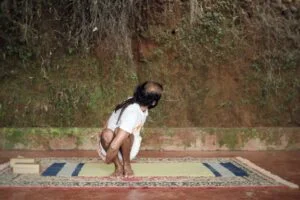
The Pasasana (Noose Pose) is a seated twisting bound pose where the arms are wrapped around the lower limbs like a noose or chord.
The posture resembles a noose—essentially a loop at the end of a rope under a running knot that tightens when pulled—created when the arms are wrapped around the folded knees.
The Sanskrit name reflects this: “Asana” means “Pose,” and “Pasa” means “Knot” or “Loop.”
Similar to the Twisted Toestand Squat, the twisting action engages the entire back, chest, and abdomen to rotate the torso fully to one side, with the hands encircling the waist and knees in a bind.
This bound spinal twist is more complex than some standing twisting poses like Parivrtta Baddha Trikonasana (Revolved Bound Triangle Pose) or Baddha Parivrtta Parsvakonasana (Bound Revolved Side Angle Pose), due to limited room for the chest and abdomen to twist and reduced arm, shoulder, and hip mobility.
The front torso muscles contract, making it challenging to breathe, bind, or maintain the hold.
The key is to use the breath effectively, progressing in a step-by-step manner. This pose can be integrated into a yoga sequence, as the binding action opens the shoulders and strengthens the core by compressing the abdominal muscles to create space for the back to twist.
Practicing the pose with props helps prepare the body, mind, and breath for the full Noose Pose.
Steps for Noose Pose:
- Start in Tadasana (Mountain Pose).
- Bend your knees fully and squat down.
- Sit completely on your feet with heels grounded.
- Swing your knees slightly to the left.
- Exhale and twist your torso to the right, bringing your left shoulder outside your right knee.
- Place your right hand on the floor.
- Wrap your left arm around both shins to reach the outer thigh.
- Breathe deeply and extend your right arm to grasp your left wrist.
- Look up and lift your chin toward your shoulder.
- Hold for 30 seconds while breathing.
- Exhale as you release and return to the center.
- Repeat on the other side.
- Sit back and unwind, releasing your hands.
Pasasana Advantages:
Lengthens, Strengthens, and Stretches
Noose Pose puts pressure on several joints:
- Ankles (supporting body weight)
- Knees (squeezing action)
- Hips (internal rotation and flexion)
- Shoulders and wrists (from the bind)
Over time, these joints gain stability through muscular engagement during the twist.
- Triceps and biceps work to lengthen the arms.
- Rib cage and intercostal muscles open to support the shoulders and upper back.
- Core and pelvis contract to support the lower back.
- Leg muscles stabilize the hips.
These muscles and joints stretch and strengthen together, improving overall stability.
Flexibility and Range of Motion
Consistent practice and longer holds in Pasasana improve the dynamic range of motion. It helps prepare the body for advanced yoga poses involving twists and binds, such as:
- Sage Marichi Pose H (Marichyasana H)
- Revolved Bird of Paradise Pose (Parivrtta Svarga Dvijasana)
Breath, Chest, and Diaphragm
The twisting motion promotes deep inhalation and clears energy channels.
This pose expands the diaphragm and contracts the intercostal muscles.
The stretching, twisting, and contracting actions reshape the function of these breathing muscles, enhancing respiratory efficiency.
Awareness and Focus (Concentration)
Begin by balancing the body in Twisted Toestand Squat.
Then, maintain the twist without losing balance.
Finally, bind the arms while opening the chest and shoulders.
Coordinating these actions with breath—inhaling, holding, and exhaling at the right time—builds awareness and prepares you for more advanced poses involving chest and rib compression.
Alignment and Posture
To maintain alignment:
- Keep feet together.
- Lengthen spine and torso before squatting.
- Raise the arm to elongate the spine before twisting.
- Wrap the arm around the knees as far back as possible.
- Ensure knees stay together in the bind.
- Ground the heels to stabilize the hips.
- Keep the neck engaged.
With proper alignment, the final posture looks graceful and improves overall body posture.
Energizing, De-Stressing, Relaxing
Pasasana is part of the Nadi Shodhana Intermediate Series, designed to open energy channels and enable the smooth flow of prana throughout the body.
This active flow energizes each cell, refreshes tissues, and removes stagnation.
It also clears mental distractions and supports decision-making.
The twist helps release stress and rejuvenate the mind and body, making you feel revitalized.
Stimulation and Organs
The squeezing action stimulates the solar plexus chakra, associated with the body’s fire element.
Twisting increases blood flow and reduces abdominal tension, providing oxygen-rich blood to internal organs.
This aids digestion and can help with urinary incontinence when practiced with the right props.
Balance and Emotions
Reaching Noose Pose should be a slow, mindful journey.
Initially, discomfort in the body, breath, and energy is expected.
With practice, this imbalance shifts into balance—uniting body, mind, and breath.
When this rhythm is achieved, emotional clarity arises, leading to a blissful state (Anandha).
This deep inner balance is the purpose of advanced poses like Pasasana.
Circulation and Systems
This pose contracts the solar plexus chakra, balancing the fire element.
Twisting improves blood circulation, eases muscle tension, and increases intra-abdominal compression, delivering fresh oxygen to the organs.
With the proper use of props, children with urinary incontinence may also experience benefits.
(Noose Pose) Pasasana Contraindications:
Injury and Surgery:
Avoid if you have injuries or surgeries involving the lower back, hips, neck, or abdominal organs. Inform your teacher even if the injury is old.
Ailment and Physical Strength:
Not recommended for those with spondylitis, IBD, arthritis, diastasis recti, blood pressure issues, or weak immunity.
Others:
Children should avoid this pose, as their spines are not ready for deep twists—even if they are naturally flexible.