
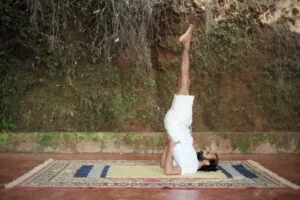
SUPPORTED SHOULDER STAND POSE AND BENEFITS
Three terms make up Sarvangasana:
- Sarva means “entire”
- Anga means “body part”
- Asana means “pose”
So, in English, this becomes the “All Body Parts Pose.”
Sarvangasana, also known as Shoulderstand Pose, is called the “Mother of all Yoga Poses” because it benefits the entire body and mind. The Supported Shoulderstand Pose is often used in flow yoga sequences to boost the body’s energy levels.
STEPS FOR SUPPORTED SHOULDER STAND
Step 1: Prepare Your Props
Fold two firm blankets into rectangles (about 1 ft x 2 ft). Stack them. You may place a sticky mat on top to keep your arms from sliding.
Step 2: Initial Setup
Lie on the blankets with your shoulders supported and your head resting on the floor. Your head should be parallel to the long edge of the blanket.
Keep your arms at your sides. Bend your knees and place your feet flat, with your heels near your sitting bones.
Step 3: Lift Off
Exhale and press your arms down. Lift your feet and draw your thighs toward your chest.
Keep your knees bent and back curved as you lift your pelvis.
Step 4: Adjust the Arms
Stretch your arms parallel to the blanket’s edge. Rotate them outward so your fingers touch the floor and your thumbs point behind you.
Bend your elbows and bring them closer together.
Step 5: Support the Back
Rest your upper arms on the blanket. Spread your hands wide on your back.
Lift your pelvis over your shoulders, keeping your torso vertical. Keep your elbows shoulder-width and avoid letting them move outward.
Step 6: Align the Body
Inhale deeply. Bend your knees toward the ceiling, heels by your buttocks, thighs aligned with your chest.
Tuck your tailbone toward your pubis. Slightly turn your upper thighs inward.
Step 7: Straighten the Legs
Inhale again. Straighten your knees and push your heels up.
Once your legs are fully extended, lift through the big toes. Make the inner legs a little longer than the outer.
Step 8: Final Alignment
Relax your throat and tongue. Squeeze shoulder blades toward your back and move the sternum toward the chin.
Your forehead should be nearly parallel to the floor, and your chin perpendicular.
Step 9: Exit the Pose
Press the tops of your shoulders and backs of your upper arms into the blanket. This will lift your upper spine.
Exhale slowly. Gently lower your back to the floor while keeping the head down.
Re-bend your knees into your chest.
BENEFITS OF SUPPORTED SHOULDERSTAND POSE (SARVANGASANA)
Health (Anatomical) Advantages
- Strengthens Shoulders: Tones and stabilizes the shoulders, reversing sagging.
- Strengthens Neck: Prevents stiffness and supports recovery from spondylitis.
- Tones Legs: Especially helpful for runners by reversing blood flow and easing muscle tension.
- Back Strengthening: Lifting and balancing strengthens the spine.
- Spine Health: Improves spinal flexibility and nervous system function.
Health Advantages
- Stimulates Glands: Activates thyroid and parathyroid glands, balancing hormones.
- Rejuvenates the Brain: Reversed blood flow increases mental clarity.
- Supports Heart Health: Strengthens heart muscles by requiring more effort to circulate blood.
- Aids Digestion: Helps relieve constipation and improve digestive health.
- Relieves Varicose Veins: Lifting legs reduces vein pressure.
- Improves Vision: Boosts blood flow to the brain, enhancing eye health.
- Supports Weight Loss: Targets fat in the hips, thighs, belly, and buttocks.
- Manages Disorders: Helps with asthma, thyroid issues, migraines, insomnia, diabetes, and reproductive issues.
- Treats Hypothyroidism: Tones the thyroid and helps regulate metabolism.
CONTRAINDICATIONS FOR SUPPORTED SHOULDER STAND (SARVANGASANA)
Avoid this pose under these conditions:
- Severe Back Pain: Not recommended for those with spinal injuries.
- Spondylitis: Avoid unless under supervision. It may help mild cases with guidance.
- Heart Problems: People with heart conditions or limited flexibility should consult a yoga expert.
- Weak Organs: If you have a weak spleen, liver, kidney, or an enlarged thyroid, avoid this pose.
- High Blood Pressure or Migraines: May worsen symptoms.
- Pregnancy or Menstruation: Not advised during these times.
- Throat or Ear Infections: Can increase pressure and worsen discomfort in the affected area.